https://ift.tt/WQTivwz This complete AI engineer roadmap covers exactly what to learn, in what order, and how long it realistically takes t...
This complete AI engineer roadmap covers exactly what to learn, in what order, and how long it realistically takes to go from your first LLM prompt to deploying production AI systems. You'll find the essential skills (Python, LLM APIs, RAG, agents), realistic timelines (8–12 months from scratch), and current salary data (\$130K–\$250K+ depending on experience).
AI engineers build the systems that connect large language models to real products: the customer support chatbot that actually resolves tickets, the internal search tool that finds answers across thousands of company documents, the AI agent that automates multi-step workflows. It's not research or model training. It's building production software with AI at the core.
We built this guide to match what the job market actually rewards in 2026, not what looked impressive two years ago. At Dataquest, our AI Engineering in Python Career Path follows this exact progression with hands-on projects from day one. Let's get into it.
Table of Contents
- Why AI Engineering Is Worth Your Investment
- What AI Engineers Actually Build
- Is AI Engineering Right for You?
- How Long This Will Take (By Your Background)
- The Complete AI Engineer Roadmap
- Common Mistakes to Avoid
- Your Next Steps
- FAQ
Why AI Engineering?
AI engineers in the United States earn a median of approximately \$142K per year according to Glassdoor (April 2026 data, based on 871 reported salaries). Entry-level positions start at \$90K–\$135K, mid-level roles pay \$140K–\$210K, and senior AI engineers can earn \$220K or more in total compensation.
The salary premium is significant. Staff-level AI engineers earn approximately 6.2% more than their non-AI peers, according to Levels.fyi's Q3 2025 compensation analysis. At major tech companies, total compensation (including equity) for AI roles ranges from \$280K at Google and Microsoft to over \$500K at OpenAI and Scale AI.
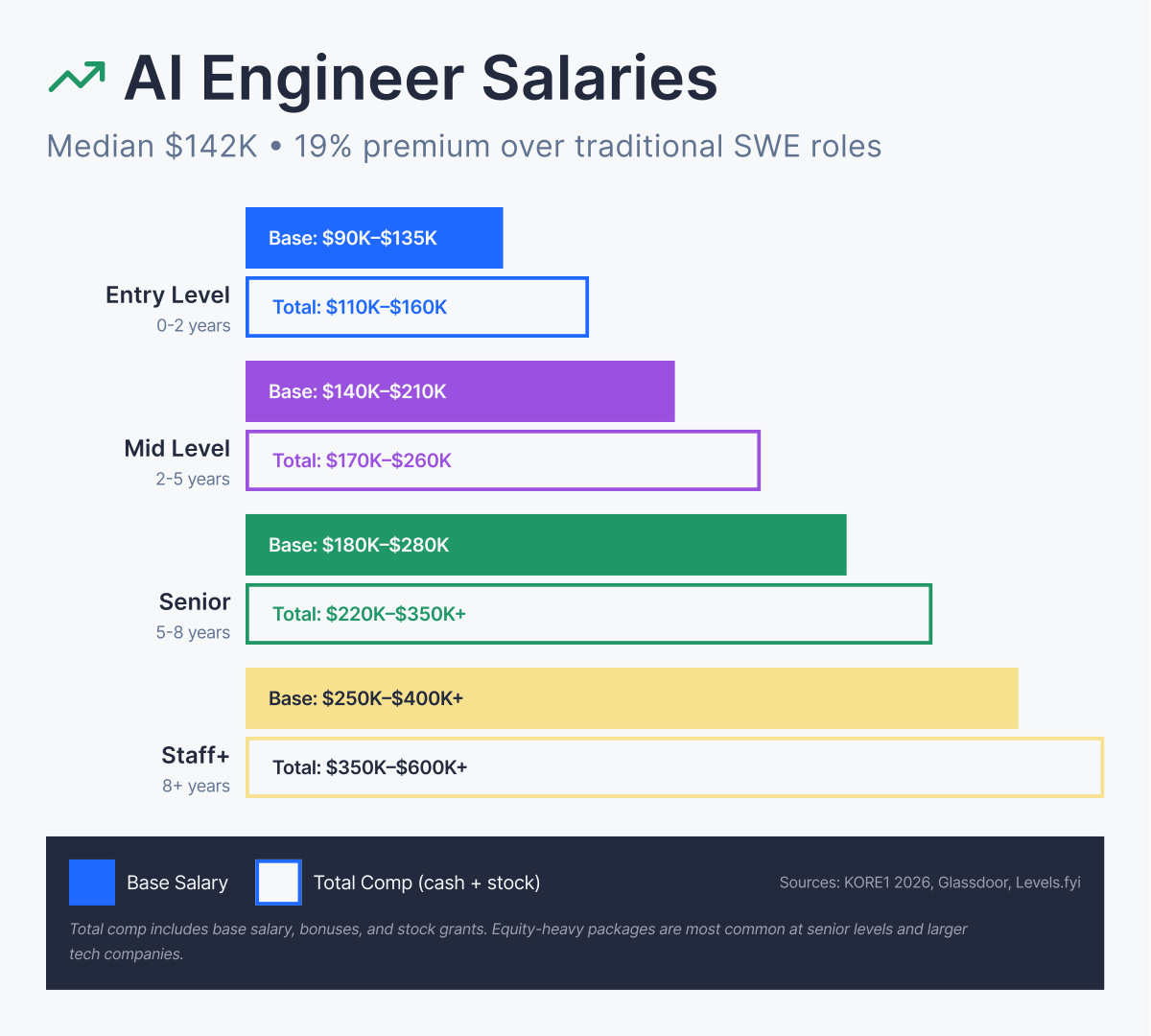
The job market is growing fast. The Bureau of Labor Statistics projects 20% growth for computer and information research scientists from 2024 to 2034, well above the 3% average across all occupations. BLS doesn't track "AI engineer" as a standalone category yet, but this is the closest proxy for the broader growth of advanced computing and AI-related work. LinkedIn ranked AI Engineer the #1 fastest-growing job title in the US for both 2025 and 2026, based on analysis of millions of job transitions. The World Economic Forum reported that AI has already created 1.3 million new roles globally, including AI Engineers, Forward-Deployed Engineers, and Data Annotators.
The tools will change. The fundamentals won't. Connecting models to real products, building reliable pipelines, and deploying systems that actually work in production? That's software engineering, and it stays valuable no matter what the next wave looks like.
What Does an AI Engineer Actually Do?
AI engineers build applications WITH pre-trained models. They don't typically train models from scratch. That distinction matters because it shapes what you need to learn.
A data scientist at your company built a sentiment analysis model. A machine learning engineer trained and optimized it. As the AI engineer, your job is to take that model (or more commonly, a pre-trained LLM like GPT-4o, Claude or one of many open-weight models) and build it into a product that customers actually use.
You connect models to real data, handle edge cases, build evaluation pipelines, and deploy the whole system to production. Let's walk through a realistic Tuesday for a mid-level AI engineer at a mid-sized tech company.
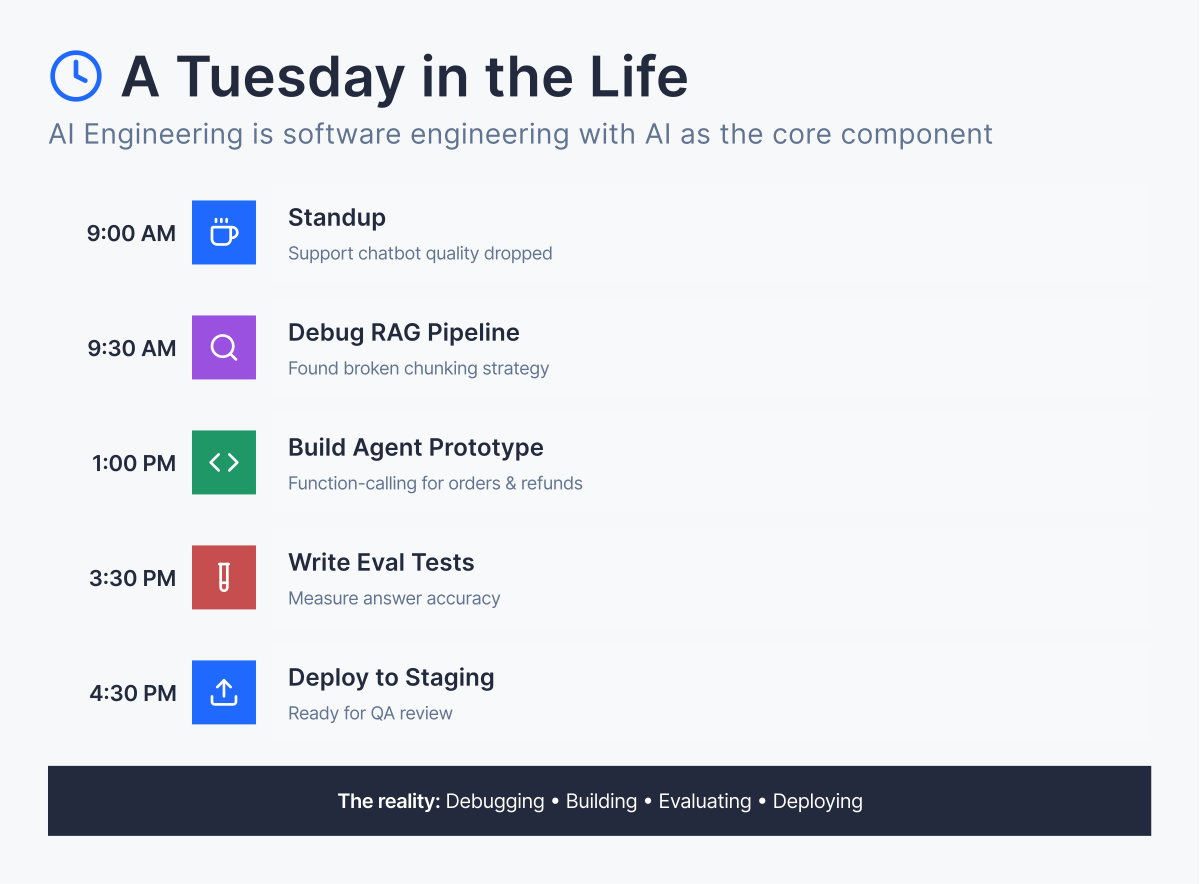
Your morning starts with a standup where you learn that the customer support chatbot's answer quality dropped over the weekend. You spend two hours investigating the RAG pipeline's retrieval layer, find that a recent document update broke the chunking strategy, and fix it.
After lunch, you build a function-calling agent prototype that lets the chatbot look up order status and initiate refunds directly. You write evaluation tests to measure answer accuracy, then deploy the updated pipeline to a staging environment for QA.
That mix of debugging, building, evaluating, and deploying is what most of your weeks look like. The work has more in common with software engineering than with academic research or model training.
AI Engineer vs. Related Roles
AI engineering overlaps with several technical roles, and the boundaries are still being drawn. You'll see job postings that use "AI engineer" and "ML engineer" interchangeably, or list data science responsibilities under an AI engineering title. The confusion is real, and it matters because studying for the wrong role wastes months. Each role has a distinct focus, and understanding where AI engineering sits relative to its neighbors will help you target your learning.
| Role | Core Focus | Primary Output | Key Tools | Math Depth | Avg US Salary (2026) |
|---|---|---|---|---|---|
| AI Engineer | Building apps using models | Chatbots, RAG systems, AI agents | LangChain, LLM APIs, vector DBs, FastAPI | Moderate | \$130K–\$250K |
| ML Engineer | Building and training models | Trained models, ML pipelines | PyTorch, TensorFlow, SageMaker | Deep | \$128K–\$220K+ |
| Data Scientist | Extracting insights from data | Analyses, dashboards, predictions | pandas, scikit-learn, SQL, Tableau | Deep | \$96K–\$150K |
| Software Engineer | Building software systems | Web apps, APIs, infrastructure | Java, JS, Python, Go, AWS | Low–Moderate | \$100K–\$180K |
Salary ranges
Note: Salary ranges might change fairly quickly as the role and the technology continue to develop. Those shown above are approximate composites from Glassdoor, KORE1, and Levels.fyi.
Is AI Engineering Right for You?
Before investing months of your time learning these skills, it's worth asking whether the day-to-day reality matches what you're looking for in a career.
Take this quick quiz to see how well AI engineering aligns with your working style and interests.
How Long Will This Take?
Timelines vary based on your starting point. These assume 10–15 hours per week of focused practice.
| Starting Background | Estimated Timeline | Why |
|---|---|---|
| From scratch (no programming) | 8–12 months | Need Python + SWE fundamentals before AI-specific skills |
| Transitioning from software engineering | 3–5 months | Strong coding foundation; need AI/LLM domain knowledge |
| Transitioning from data science / ML | 3–6 months | Statistical foundations set; need SWE and deployment skills |
| Transitioning from data analysis | 6–9 months | SQL and analytics transfer; need Python depth and SWE fundamentals |
These are "job-ready" timelines, meaning you can apply for AI engineering roles and have a portfolio to show. Not "expert" timelines. One commenter on r/learnmachinelearning noted that the field is moving so fast that companies themselves aren't always sure what work to assign AI engineers, but the fundamentals (Python, APIs, understanding the model lifecycle) remain stable regardless of which framework is trending.
Our AI Engineering path covers this progression in 193+ hours of hands-on learning, with your progress from other Dataquest paths (Data Scientist, Data Engineer) carrying over automatically.
The Complete AI Engineer Roadmap
The roadmap below is broken into four phases that build on each other. You'll start with Python and software engineering fundamentals, move into LLM APIs and prompt engineering, build production RAG systems, and finish with agents, deployment, and a portfolio that proves you can ship.
Expand each phase below to see the specific skills, tools, code examples, milestone projects, and learning resources for each stage of the journey.
- Variables, data types, lists, loops, and conditionals
- Dictionaries and data structures
- Working with APIs using the requests library
- Writing reusable functions
Introduction to Python Programming ↗
Python Dictionaries, APIs, and Functions ↗
- Object-oriented programming (basic and intermediate)
- List comprehensions and lambda functions
- Decorators and regular expressions
- Error handling and input validation
- CLI navigation and file management
- Virtual environments and environment variables
- Git basics: clone, branch, commit, merge, pull requests
- Setting up and customizing your IDE
- AI chatbot capabilities and limitations
- Tokenization and context windows
- Model families: GPT, Claude, Gemini, Llama, Mistral, DeepSeek
- Choosing the right model for the job
- OpenAI Chat Completions API
- Managing conversation context and token budgets
- Prompting techniques for reliable, high-quality responses
- Structured outputs and validation with Pydantic
- Function calling and agentic tool loops
- Building reusable tool servers with MCP
- Query parameters and data filtering
- Authentication methods and API keys
- Rate limits and pagination strategies
- Building LLM-powered APIs with FastAPI
- Containerizing applications with Docker
- Multi-service architectures with Docker Compose
- Production patterns: health checks, multi-stage builds, non-root users
- NumPy arrays and boolean indexing
- Pandas: exploration, cleaning, aggregation, combining datasets
- String manipulation and handling missing data
- Visualization: line graphs, scatter plots, histograms, distributions
Introduction to Pandas and NumPy ↗
Data Visualization in Python ↗
Data Cleaning and Analysis ↗
- Sampling and frequency distributions
- Central tendency, variability, and z-scores
- Probability rules, permutations, and combinations
- Bayes' theorem and Naive Bayes classifiers
- Hypothesis testing and chi-squared tests
Introduction to Statistics ↗
Intermediate Statistics ↗
Probability in Python ↗
Hypothesis Testing ↗
- Supervised ML: KNN, model evaluation, hyperparameter tuning
- Unsupervised ML: K-means clustering
- Calculus for ML: functions, limits, optimization
- Linear algebra: vectors, matrices, linear systems
Introduction to Supervised ML ↗
Introduction to Unsupervised ML ↗
Calculus for ML ↗
Linear Algebra for ML ↗
- Linear and logistic regression
- Gradient descent optimization
- Decision trees and random forests
- Cross-validation, regularization, and feature engineering
Linear Regression Modeling ↗
Logistic Regression Modeling ↗
Decision Tree and Random Forest ↗
Optimizing ML Models ↗
- Sequence models and time series
- Natural language processing (NLP)
- Computer vision with CNNs
- Building and training a pneumonia detection model
- Generating embeddings with APIs and open models
- Visualizing high-dimensional embeddings
- Similarity metrics: cosine similarity, Euclidean distance, dot product
- Building semantic search systems
- ChromaDB fundamentals and HNSW indexing
- Document chunking strategies
- Metadata filtering and hybrid search
- Production databases: pgvector, Qdrant, Pinecone
- Semantic caching and memory patterns
- RAG architecture: retrieval, context management, grounded generation
- Advanced retrieval: query expansion and reranking
- Diagnosing common failure modes
- Security and prompt injection defense
- Self-RAG and autonomous evaluation
- Foundation metrics and evaluation frameworks
- LLM-as-Judge and automated evaluation
- Production observability and monitoring
- Agent architectures and tool use patterns
- Building agents with function calling
- Memory, state management, and planning strategies
- Multi-agent orchestration
- Agent evaluation and safety
The roadmap is designed to get you building from day one. In the Dataquest AI Engineering path, Phase 1 ends with a Food Ordering App built with Python. Phase 2 takes you through a Dynamic AI Chatbot, a Multi-Provider LLM Gateway, and a fully deployed AI service with FastAPI and Docker. Phase 3 builds your data and ML foundations through projects like heart disease prediction and a pneumonia detection CNN. Phase 4 covers embeddings, vector databases, and RAG systems, with a Knowledge Base Search System as the capstone project. AI agents and LLM evaluation content is being added to the path on a rolling basis. Each phase produces something real, not just notes from a lecture.
One piece of advice: start applying for jobs after Phase 3. Don't wait until you feel "ready." The practitioners who get hired are the ones who can show working projects, not the ones who completed every course. By the time you finish the Dataquest AI Engineering path, you'll have 19 portfolio projects, with more added as new courses are released.
Common Mistakes to Avoid
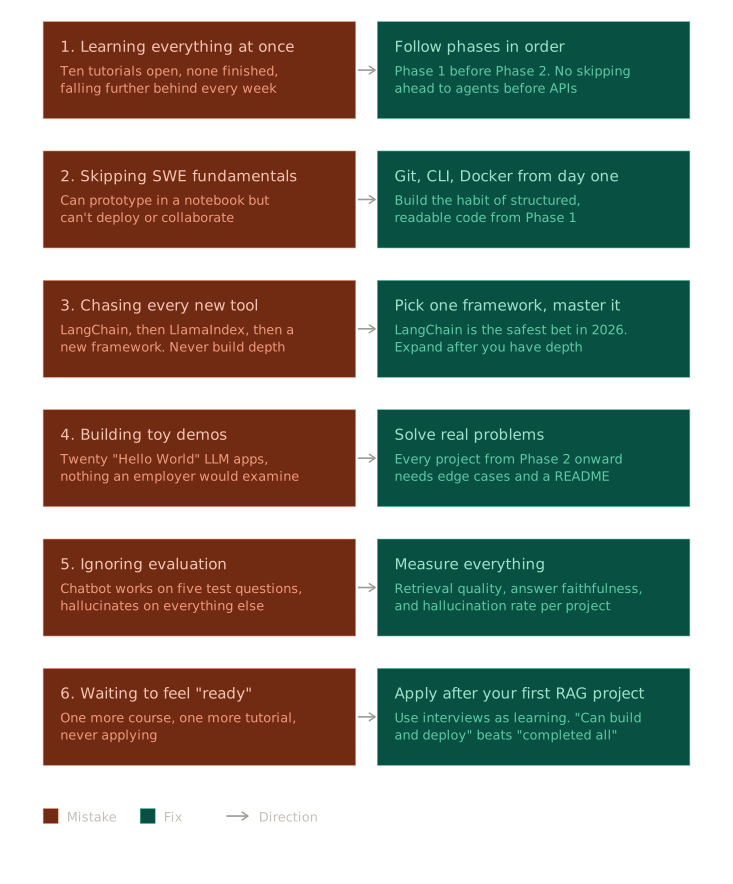
We've seen the same patterns trip up learners across our community, Reddit threads, and support conversations. Most of them come down to one thing: skipping the uncomfortable work in favor of something that feels more productive. The thread connecting all six: build real things, in order, with one tool at a time, and start showing your work before you feel ready. The roadmap below is sequenced specifically to prevent these traps.
Your Next Steps
In the next 24 hours:
- Bookmark this roadmap
- Create a GitHub account if you don't have one
- Start the AI Engineering in Python Career Path — the first lesson walks you through writing your first Python code
- Write your first Python function
This week:
Complete 3–5 Python lessons. Get comfortable with variables, data types, and basic control flow. If you already know Python, skip ahead to the Intermediate Python for AI Engineering course. Join one community (Reddit or Dataquest Community).
This month:
Make real progress on Phase 1 foundations. Build your first small project and push it to GitHub. If you want a structured path, start the full AI Engineering path.
Documentation to bookmark: LangChain, LlamaIndex, OpenAI API, Anthropic API, FastAPI. You can also explore our full catalog of AI courses.
Wrapping up
AI engineering pays well, the problems are interesting, and the path is clearer than you might think. Plan on 8 to 12 months of consistent work. You'll move through Python foundations, LLM fundamentals, RAG pipelines, and eventually agents and production deployment.
The roadmap is a guide, not a prescription. Move at your pace. What matters is consistent progress and building real things you can show. The Dataquest AI Engineering Career Path follows this exact progression with hands-on projects, so you're building your portfolio from day one.
FAQ
Do I need a degree to become an AI engineer?
No.
While a CS or math degree helps, most employers prioritize demonstrated skill over credentials.
A portfolio of deployed projects carries more weight than a diploma for the majority of AI engineering roles.
That said, some research-oriented positions at major tech companies may prefer advanced degrees. For more on credentials, see our guide to the best AI certifications in 2026.
Can I become an AI engineer without a computer science background?
Yes.
Many successful AI engineers transitioned from data analysis, software engineering, or non-technical fields.
The key is investing time in Python and software engineering fundamentals (Phase 1 of this roadmap).
Career changers should plan for 8–12 months of focused learning.
How much do AI engineers make?
AI engineers in the US earn a median of approximately \$142K per year according to Glassdoor (April 2026 data).
Entry-level roles start at \$90K–\$135K, mid-level at \$140K–\$210K, and senior roles exceed \$220K.
At top tech companies, total compensation can reach \$300K–\$600K+ including equity, according to Levels.fyi.
Is Python enough for AI engineering?
Python covers approximately 90%+ of the work.
You'll also need to be comfortable with basic command-line tools, Git, and web technologies (HTTP, REST, JSON).
SQL is useful but not essential for most AI engineering roles.
What's the difference between an AI engineer and a machine learning engineer?
AI engineers build applications USING pre-trained models, connecting LLMs to products via APIs, RAG, and agents.
ML engineers build, train, and optimize the models themselves.
AI engineering requires less math and more software engineering, while ML engineering requires a deeper understanding of statistics and model architecture.
Can I learn AI engineering in 6 months?
It depends on your starting point.
If you already know Python and have software engineering experience, 3–5 months is realistic.
Starting from scratch, 6 months is very aggressive. Plan for 8–12 months, especially if you're working or studying simultaneously.
What should I learn first for AI engineering?
Python. Everything else builds on it.
After that: APIs and web fundamentals, then LLM APIs and prompt engineering.
Don't skip to RAG or agents before you're comfortable making API calls and handling JSON data.
Will AI replace AI engineers?
AI tools are changing how AI engineers work.
AI-generated code now accounts for a significant and growing share of total code output.
But this makes AI engineers more productive, not redundant.
Someone still needs to architect systems, evaluate quality, handle edge cases, and make product decisions.
The role is evolving, not disappearing.
What certifications do AI engineers need?
No certification is required, but cloud certifications (AWS ML Specialty, GCP Professional ML Engineer) are the most recognized supplements to a portfolio.
Avoid expensive bootcamp certificates with no brand recognition.
For a breakdown of options, see our best AI certifications guide.
Are AI agents the future of AI engineering?
Agents are the fastest-growing area in the field.
Multi-step workflows that can reason, plan, and take actions are becoming standard in production systems.
Protocols like MCP (Model Context Protocol) and frameworks like LangGraph and CrewAI are making agents more practical.
This is likely where most AI engineering work will concentrate over the next two to three years.
from Dataquest https://ift.tt/8piBmzk
via RiYo Analytics

No comments