https://ift.tt/CmD9tXB Most "best deep learning courses" lists mix up three very different things: general AI literacy courses, c...
Most "best deep learning courses" lists mix up three very different things: general AI literacy courses, courses about using pre-trained models, and courses that actually teach you how neural networks work and how to train them yourself. If you've been searching and the recommendations feel scattered, that's why.
This guide covers the third category only. We compared the top 10 deep learning courses across cost, time commitment, framework, learning format, and the audience each one serves. Every entry includes honest limitations alongside strengths, organized by what you're trying to accomplish rather than arbitrary rankings. By the end, you'll know which course fits your goals and where to start this week.
Best Deep Learning Courses: Top Picks by Goal
Want the short version? Here are the strongest picks by goal:
- Best hands-on intro: Dataquest Introduction to Deep Learning in PyTorch
- Best comprehensive specialization: Deep Learning Specialization (Andrew Ng, Coursera)
- Best free university lecture series: MIT 6.S191: Introduction to Deep Learning
- Best for applied deep learning domains: Dataquest Deep Learning Applications in PyTorch
- Best budget Udemy option: Deep Learning A-Z (Kirill Eremenko)
Best Deep Learning Courses Compared at a Glance
| Course | Cost | Time | Format | Framework | Best For |
|---|---|---|---|---|---|
| Dataquest Intro to DL in PyTorch | Free intro / \$49/mo | 12 hr | Interactive browser | PyTorch | Data professionals |
| Deep Learning Specialization (Andrew Ng) | Free audit / \$49/mo | ~4 mo at 5 hr/wk | Video + labs | TensorFlow | Comprehensive learners |
| fast.ai Practical Deep Learning | Free | ~7 wk (20+ hr) | Video + notebooks | PyTorch (fastai) | Practical builders |
| MIT 6.S191 | Free | ~5 wk | Video + Colab labs | TensorFlow | Academic learners |
| Dataquest DL Applications in PyTorch | Free intro / \$49/mo | 8 hr | Interactive browser | PyTorch | Applied practitioners |
| NYU Deep Learning (LeCun & Canziani) | Free | ~14 wk | Video + notebooks | PyTorch | Theory-driven learners |
| Dive into Deep Learning (d2l.ai) | Free | Self-paced | Interactive textbook | Multi-framework | Self-directed learners |
| Deep Learning A-Z (Udemy) | \$15-60 | ~22.5 hr | Video + projects | TensorFlow/Keras | Budget learners |
| TensorFlow Developer Certificate | Free audit / \$49/mo | ~4 mo at 5 hr/wk | Video + labs | TensorFlow | TF-focused teams |
| 3Blue1Brown + Karpathy | Free | ~19 hr | YouTube | Python/PyTorch | Visual/intuitive learners |
For the full breakdown of cost, learning format, and what each course delivers, keep reading.
What This Guide Covers (and What It Doesn't)
"Deep learning" gets used loosely in course titles, and that looseness creates confusion. Some courses labeled "deep learning" are really AI literacy courses. Others focus on building applications with pre-trained models rather than training your own. If either of those is what you need, we have separate guides: our Best AI Courses guide covers the full AI landscape from tools to engineering, and our Best Generative AI Courses guide covers prompt engineering, RAG, agents, and LLM application development.
This guide answers a specific question: "I want to understand how neural networks work and learn to train deep learning models myself." The courses below teach you to build and train convolutional neural networks, recurrent neural networks, and other deep learning architectures from the ground up.
The Framework Question: PyTorch or TensorFlow?
Framework choice is the first real decision a deep learning learner faces, and it causes more analysis paralysis than it should. The diagram below will help you navigate this decision:
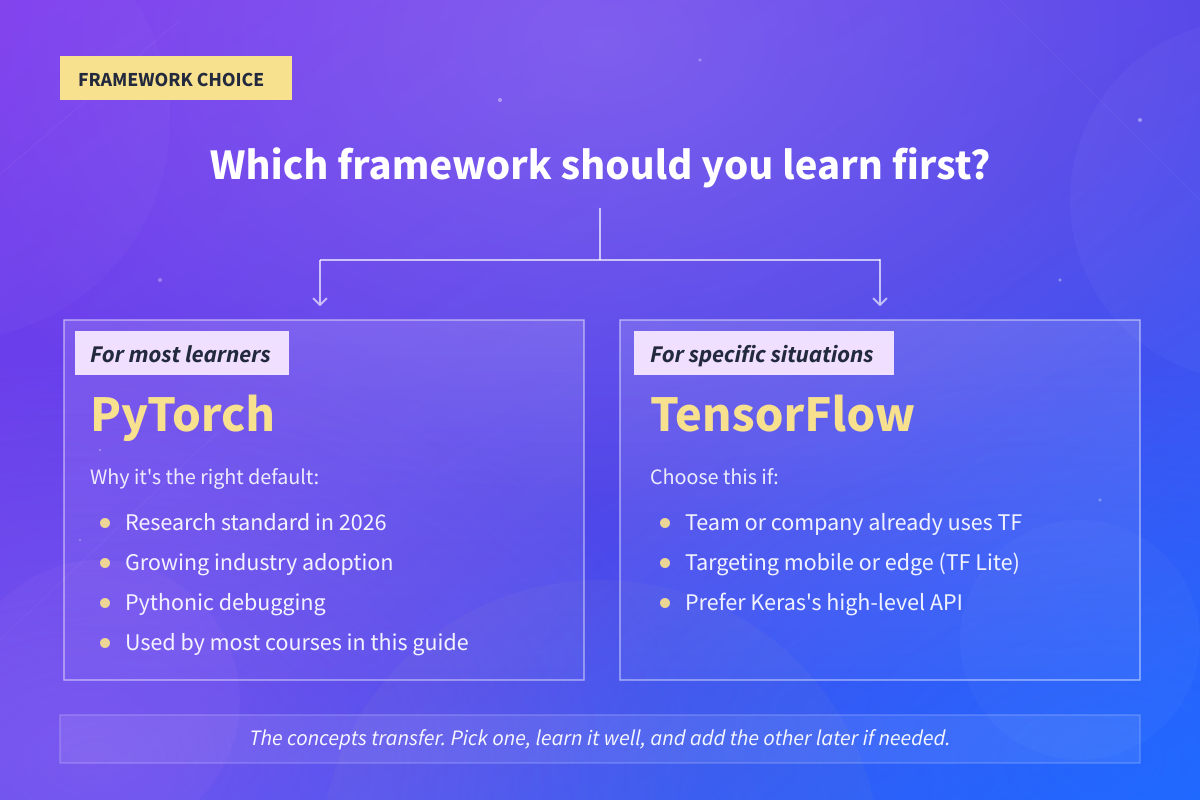
- PyTorch is the right default for most new learners in 2026. It dominates research, its industry adoption has been growing steadily, and its Pythonic interface makes debugging more intuitive than TensorFlow's historically graph-based approach. According to the O'Reilly Technology Trends report for 2025, TensorFlow content usage declined 28% while PyTorch continued to gain ground, reflecting a broader shift across the field.
- TensorFlow is not a wrong choice if it matches your situation. If your team or company has an existing TensorFlow codebase, if you're targeting mobile or edge deployment with TensorFlow Lite, or if you prefer Keras's high-level API for rapid prototyping, TensorFlow still has a strong ecosystem and active community. The concepts you learn in either framework transfer to the other, and most experienced deep learning engineers are comfortable in both.
The courses on our list include options for both frameworks, and each entry notes which one it uses. Don't let framework choice delay you. Pick the one that matches your situation, learn it well, and add the other later if your work requires it.
Best Deep Learning Courses for Building Foundations
These courses teach neural network fundamentals from the ground up. Whether you're a data professional adding deep learning to your toolkit, a developer making a career shift, or a student building core knowledge, this section covers the best starting points.
1. Dataquest Introduction to Deep Learning in PyTorch

- Cost: Free intro lessons (no credit card required). Full course access requires a paid plan: \$49/month or \$399/year.
- Time to Complete: 12 hours, self-paced.
- Prerequisites: Python proficiency and familiarity with machine learning basics (gradient descent, train/test splits).
- What You'll Learn:
- Deep learning fundamentals and how neural networks learn from data
- PyTorch tensors, autograd, and the computational graph
- Building neural networks with nn.Sequential
- Proper three-way data splitting with stratification and scaling
- Production-grade regularization: dropout, batch normalization, and early stopping
- Comprehensive model evaluation practices
- Industry Recognition: 4.79/5 on CourseReport. 468 learners enrolled in this course. Part of the Data Scientist (Python) career path.
- Best For: Data analysts, data scientists, and ML practitioners who already know Python and want to add deep learning to their skill set through hands-on building rather than passive lectures.
Why it works: Most deep learning courses teach the math first and the building second, often through computer vision examples. Dataquest's Introduction to Deep Learning in PyTorch flips that order and uses tabular data, which is closer to the work most data professionals actually do. You write code in the same browser window where you're learning, with each lesson building on the last.
The course emphasizes production-grade practices: proper data splitting methodology, regularization techniques like dropout and batch normalization, and evaluation approaches that tell you whether your model will generalize. These aren't afterthoughts. They're treated as core skills.
Worth knowing: This is a single course, not a full specialization. It covers neural network fundamentals and training methodology thoroughly, but doesn't extend into CNNs, RNNs, or NLP. Learners wanting those domain-specific applications should continue with Deep Learning Applications in PyTorch, covered in the next section of this guide.
2. Deep Learning Specialization (Andrew Ng, DeepLearning.AI, on Coursera)
- Cost: Free to audit individual courses. \$49/month for the specialization certificate, or \$59/month for Coursera Plus (which includes access to thousands of other courses).
- Time to Complete: ~4 months at 5 hours/week (5 courses).
- Prerequisites: Basic Python, basic machine learning concepts (helpful but not strictly required).
- What You'll Learn:
- Neural networks and deep learning fundamentals
- Hyperparameter tuning, regularization, and optimization
- Structuring machine learning projects and error analysis
- Convolutional neural networks for computer vision
- Sequence models including RNNs, LSTMs, and attention mechanisms
- Industry Recognition: 4.9/5 rating with 120,000+ reviews. Taught by Andrew Ng, co-founder of Coursera and founder of DeepLearning.AI.
- Best For: Learners who want a comprehensive, theory-grounded deep learning education from the most recognized name in AI education, and who are willing to invest 4 months to get it.
Why it works: Andrew Ng's Deep Learning Specialization is the canonical deep learning education. The five-course structure builds methodically from single neurons to sequence models and attention mechanisms. Ng's teaching breaks complex math into intuitive explanations, and the programming assignments have you implement algorithms from scratch before using frameworks.
The specialization also includes a course on structuring ML projects, drawn from Ng's experience at Google Brain and Baidu. That practical layer (diagnosing errors, deciding when to collect more data) is something most courses skip.
Worth knowing: The specialization uses TensorFlow, not PyTorch. The underlying concepts transfer fully between frameworks, but the code examples won't map directly to PyTorch workflows. Some TF code patterns also show their age. The free audit option lets you access lectures and most materials, but graded assignments and certificates require payment.
3. fast.ai Practical Deep Learning for Coders
- Cost: Free (all materials, videos, and notebooks are open access).
- Time to Complete: ~7 weeks (20+ hours of video content, plus significant practice time).
- Prerequisites: At least one year of coding experience (Python preferred) and high-school math.
- What You'll Learn:
- Building and training deep learning models for computer vision, NLP, tabular analysis, and collaborative filtering
- Using the PyTorch and fastai libraries
- Transfer learning and fine-tuning pre-trained models
- Setting up cloud GPU environments for model training
- Deploying models to production using Hugging Face Spaces and Gradio
- Industry Recognition: Studied by hundreds of thousands of learners worldwide. Multiple students have won international ML competitions (including Kaggle) after completing the course.
- Best For: Developers and coders who want to start building working deep learning models immediately and learn the theory as they go, rather than studying math first.
Why it works: Jeremy Howard's approach is the inverse of Andrew Ng's, and both work. Where Ng starts with theory, fast.ai starts with complete, working models and gradually digs into how they work. In lesson one, you train a state-of-the-art image classifier. By the end, you understand backpropagation, SGD, and the architecture decisions that made it work.
The top-down approach has a track record. Fast.ai students have won international ML competitions, landed top-company offers, and published research papers. The active forums have thousands of similar stories.
Worth knowing: This course was recorded in 2022, making it four years old. The core concepts are still relevant and widely recommended, but fastai library versions have changed and some deployment patterns have evolved. Expect translation work between course code and current docs.
The fastai library also adds abstraction on top of PyTorch that can mask framework-level details. Supplement with a vanilla PyTorch course if you need that fluency.
4. MIT 6.S191: Introduction to Deep Learning
- Cost: Free (lectures on YouTube, labs on Google Colab).
- Time to Complete: ~5 weeks of lectures and labs.
- Prerequisites: Calculus (derivatives), linear algebra (matrix multiplication), and Python. The instructors cover everything else.
- What You'll Learn:
- Deep learning foundations and neural network architecture
- Computer vision and convolutional neural networks
- Deep generative modeling
- Reinforcement learning
- Large language models and NLP
- Text-to-image generation
- Industry Recognition: MIT's official introductory deep learning course. Taught by MIT PhD researchers Alexander Amini and Ava Amini. Updated annually since 2017, with the 2026 edition covering current topics including LLMs and generative models.
- Best For: Learners who want a compact, current, university-level introduction to deep learning with hands-on labs, and who have the math background to keep pace.
Why it works: MIT 6.S191 covers an impressive amount of ground quickly. The 2026 edition runs through deep learning foundations, computer vision, generative models, reinforcement learning, and LLMs in roughly five weeks. The annual syllabus refresh is a genuine differentiator: while many courses become outdated within a year, 6.S191 updates every year to reflect the latest developments. Google Colab labs let you run experiments without local setup.
Worth knowing: The compressed format means each topic gets less depth than a full specialization. Learners without calculus and linear algebra may struggle, especially in later lectures. The labs use TensorFlow, and there are no graded assignments or certificates for external learners.
Best Deep Learning Courses for Going Deeper
These courses serve learners who have some machine learning background and want more depth, more breadth across application domains, or a more rigorous theoretical foundation. If you've completed a foundations course and want to expand what you can build, this section is for you.
5. Dataquest Deep Learning Applications in PyTorch
- Cost: Free intro lessons (no credit card required). Full course access requires a paid plan: \$49/month or \$399/year.
- Time to Complete: 8 hours, self-paced.
- Prerequisites: Deep learning fundamentals (the Introduction to Deep Learning in PyTorch course or equivalent).
- What You'll Learn:
- How PyTorch is used across major deep learning application areas
- Sequence models and when to apply them
- Natural language processing with deep learning
- Computer vision models and architectures
- Recognizing which model types fit which problem domains
- Industry Recognition: 4.8/5 ratings. Part of the AI Engineer (Python) career path.
- Best For: Learners who have completed a deep learning fundamentals course and want practical exposure to how neural networks are applied across different problem domains, including sequences, text, and images.
Why it works: Most deep learning fundamentals courses stop at fully connected networks and leave you to figure out domain-specific architectures on your own. Dataquest's Deep Learning Applications course bridges that gap, showing how deep learning techniques are structured differently for sequence data, natural language, and computer vision tasks.
You write code in the browser, get immediate feedback, and build working models in each domain. The emphasis is on recognizing when to apply different model types and understanding how input data shapes model design.
Worth knowing: At 8 hours, this course prioritizes breadth of exposure across domains over deep specialization. If your goal is NLP or computer vision expertise specifically, you'll need more focused courses afterward. If you're already paying for Dataquest access, there's no additional cost. But if you're signing up for this course alone, evaluate whether the time commitment justifies a monthly subscription versus free domain-specific alternatives.
6. NYU Deep Learning (Yann LeCun & Alfredo Canziani)
- Cost: Free (lectures on YouTube, notebooks and notes on GitHub).
- Time to Complete: ~14 weeks of lectures and practicals.
- Prerequisites: A graduate-level machine learning course or equivalent experience. Python and PyTorch basics.
- What You'll Learn:
- Supervised and unsupervised deep learning
- Energy-based models (a unifying framework for understanding DL)
- Embedding methods and metric learning
- Convolutional and recurrent neural networks
- Transformers, attention, and self-supervised learning
- Applications to computer vision, NLP, and speech recognition
- Industry Recognition: Taught by Yann LeCun (Turing Award recipient, Chief AI Scientist at Meta, considered the father of convolutional neural networks) and Alfredo Canziani (NYU research professor).
- Best For: Learners with existing ML knowledge who want the deepest possible conceptual understanding of how and why deep learning works, from someone who helped invent the field.
Why it works: LeCun and Canziani teach deep learning through an energy-based model framework that strips away unnecessary complexity and unifies concepts that other courses treat separately. Canziani's visual effects make the abstract feel concrete, and PyTorch notebooks let you implement each concept alongside the lectures.
The depth is genuinely graduate-level, covering topics like energy-based self-supervised learning, graph convolutional networks, and planning under uncertainty that most courses never touch.
Worth knowing: The prerequisites are real. Without at least one introductory ML course, the pace will be overwhelming. The energy-based framing is elegant but unconventional, so you won't find it reinforced in other courses or textbooks.
The publicly available lectures and notebooks are from Spring 2021, making them five years old. The course is still actively taught at NYU (Spring 2026), but newer materials aren't publicly available. The deep learning fundamentals are timeless, though application examples and tooling references predate the current generative AI landscape.
7. Dive into Deep Learning (d2l.ai)
- Cost: Free (interactive online textbook; also available in print from Cambridge University Press).
- Time to Complete: Self-paced (the textbook covers roughly 1,000 pages across 20+ chapters).
- Prerequisites: Basic Python, introductory probability and statistics, basic linear algebra.
- What You'll Learn:
- Deep learning from first principles through advanced topics
- Linear neural networks, multilayer perceptrons, and deep learning computation
- Convolutional neural networks, recurrent neural networks, and attention mechanisms
- Optimization algorithms, computational performance, and hardware acceleration
- Computer vision and natural language processing applications
- Generative models, recommender systems, and reinforcement learning
- Industry Recognition: Adopted at 500+ universities across 70 countries, including Stanford, MIT, Harvard, and Cambridge. Published by Cambridge University Press. Endorsed by Jensen Huang (NVIDIA CEO).
- Best For: Disciplined self-directed learners who want the most comprehensive deep learning resource available, combining textbook depth with executable code, and who don't mind working at their own pace without video lectures.
Why it works: Dive into Deep Learning is a textbook where every equation has runnable code next to it. Every concept is illustrated with figures, implemented in Python, and presented with mathematical rigor alongside practical intuition. The book supports PyTorch, TensorFlow, JAX, and NumPy/MXNet side by side, so you can learn in whatever framework you prefer.
The scope covers everything from linear regression through transformers, GANs, and reinforcement learning. Adoption at 500+ universities reflects both content quality and the value of executable code alongside every explanation.
Worth knowing: This is a textbook, not a video course. Learners who need instructors or deadlines should pair it with a structured course (fast.ai or Ng's specialization work well as companions). The best approach for most learners is to use d2l.ai as a reference alongside a structured course rather than reading cover to cover.
Best Deep Learning Courses on a Budget
Not everyone needs a subscription platform or a multi-month specialization. These options deliver genuine deep learning education at low or zero cost, making them ideal for learners who want to explore the field before committing, or who learn best outside of traditional course structures.
8. Deep Learning A-Z (Kirill Eremenko & Hadelin de Ponteves, on Udemy)

- Cost: \$15-60 on Udemy (frequently on sale; lifetime access).
- Time to Complete: ~22.5 hours of video content.
- Prerequisites: Basic Python. Some high-school math.
- What You'll Learn:
- Artificial neural networks and how to build them from scratch
- Convolutional neural networks for image classification
- Recurrent neural networks and LSTMs for sequential data
- Self-organizing maps for unsupervised learning
- Boltzmann machines and autoencoders
- Deep learning model deployment on AWS
- Industry Recognition: 485,000+ students, 4.5/5 rating with 46,000+ reviews. One of the longest-running and most-enrolled deep learning courses on Udemy.
- Best For: Learners on a budget who want a broad survey of deep learning architectures at an affordable one-time price, and who are comfortable with video-based learning.
Why it works: Deep Learning A-Z takes the "intuition first, then implementation" approach. Each section starts with a conceptual explanation before walking through code. Eremenko and de Ponteves are well-regarded for making complex topics accessible. At sale prices (\$15-20 is common), the cost-per-hour ratio is hard to beat.
Worth knowing: This is breadth-first. You'll touch six architectures without going deep on any. The code uses TensorFlow/Keras, and some sections reference older patterns. Best used as an affordable survey that helps you decide which area of deep learning to specialize in next.
9. TensorFlow Developer Professional Certificate (DeepLearning.AI, on Coursera)
- Cost: Free to audit individual courses. \$49/month for the certificate (Coursera Plus at \$59/month also includes access).
- Time to Complete: ~4 months at 5 hours/week (4 courses).
- Prerequisites: Python basics. Some experience with machine learning concepts is helpful.
- What You'll Learn:
- Building neural networks in TensorFlow for classification and regression
- Convolutional neural networks for image classification
- Natural language processing with tokenization and embeddings
- Sequence models and time series forecasting
- Industry Recognition: Taught by Laurence Moroney of Google. Prepares for the Google TensorFlow Developer Certificate exam. Recognized as a structured pathway for TensorFlow fluency.
- Best For: Learners whose team or company uses TensorFlow, or who specifically want TensorFlow framework fluency and a credential that signals it to employers.
Why it works: The TensorFlow Developer Professional Certificate is the most structured path to TensorFlow fluency available. Four courses move from basic neural networks through CNNs, NLP, and time series, all in TensorFlow. The credential prepares you for the Google TensorFlow Developer Certificate exam, which has some weight with employers running TF in production.
Worth knowing: This is framework training, not a comprehensive deep learning education. The theory of why architectures work gets less attention than in Ng's specialization or fast.ai. If your goal is deep learning understanding rather than TF proficiency, start with a foundations course first.
10. 3Blue1Brown Neural Networks Series + Andrej Karpathy's Neural Networks: Zero to Hero
- Cost: Free (YouTube).
- Time to Complete: ~4 hours (3Blue1Brown) + ~15 hours (Karpathy). Both are self-paced.
- Prerequisites: 3Blue1Brown requires no math background (it builds the intuition visually). Karpathy requires Python comfort and basic calculus.
- What You'll Learn:
- How neural networks actually learn (3Blue1Brown: visual, geometric intuition for gradient descent, backpropagation, and network structure)
- Building a GPT-class language model from scratch in pure Python and PyTorch (Karpathy: character-level language models, bigram models, MLP, RNN, GRU, and transformers, all implemented step by step)
- Industry Recognition: 3Blue1Brown's neural network series has tens of millions of views and is widely referenced in university courses. Andrej Karpathy is the former head of AI at Tesla, former researcher at OpenAI, and a Stanford PhD. His "Zero to Hero" series is regarded across Reddit, Hacker News, and ML communities as the single best free resource for understanding neural networks from the ground up.
- Best For: Learners who want to build deep, intuitive understanding of how neural networks work before committing to a structured course, or who learn best through visual explanations and code-along building.
Why it works: This combination is the most recommended free deep learning resource across practitioner communities. 3Blue1Brown's neural network series builds geometric intuition for what a neural network does when it "learns," making gradient descent and backpropagation feel spatial and concrete. Karpathy's Zero to Hero turns that intuition into code: you build increasingly sophisticated language models from scratch, ending with a working transformer.
Worth knowing: No assignments, no grading, no certificates, and no structured curriculum connecting the two series. Learners who need external accountability should use this as a supplement to a structured course, not a replacement.
When You Don't Need a Deep Learning Course
A course isn't always the right move. Here are four situations where you should skip it and take a different path:
- You want to use pre-trained models, not train your own. Most AI applications in 2026 involve calling APIs, building RAG pipelines, or designing agent workflows. That's covered in our Best Generative AI Courses guide, not here.
- You're stuck in tutorial hell. If you've started three deep learning courses and finished none, the fourth won't fix the pattern. Pick one, finish it, build a project.
- You have a narrow, specific problem. Adding one CNN layer to an existing pipeline? Fine-tuning a model on your company's data? The PyTorch official tutorials and TensorFlow guides will get you there faster than a 40-hour course.
- You learn better from books. Dive into Deep Learning is covered in this guide. Ian Goodfellow's Deep Learning remains a strong theoretical reference. Deep Learning with Python by François Chollet is the best applied reference for TensorFlow users.
Your Next Move: Picking a Deep Learning Course
If you're still comparing options, here is a quick decision shortcut based on where you are right now:
- You're a data professional who wants to add deep learning in PyTorch: Start with Dataquest's Introduction to Deep Learning in PyTorch. Hands-on, tabular-data-focused, and built for people who already work with data.
- You want the most comprehensive education and have 4 months: Choose Andrew Ng's Deep Learning Specialization. It's still the canonical deep learning education.
- You want to build working models immediately, for free: Start with fast.ai. Top-down teaching gets you to results fastest.
- You want a compact, current university course, for free: Choose MIT 6.S191. Updated annually, lab exercises included.
- You want the deepest intuitive understanding before committing: Watch 3Blue1Brown's neural network series, then work through Karpathy's Zero to Hero.
If your team or company uses TensorFlow, Dataquest also offers a Deep Learning in TensorFlow skill path that covers the fundamentals in TF. And if you're exploring whether deep learning is the right specialization at all, our Machine Learning in Python skill path builds the prerequisite foundation.
Pick one course this week. Block time on your calendar. Finish it before enrolling in another. The biggest predictor of whether you'll learn deep learning isn't which course you choose. It's whether you complete what you start and build something with what you learn.
Frequently Asked Questions
Do I need to learn machine learning before deep learning?
For most courses in this guide, yes, at least the basics. Concepts like gradient descent, overfitting, train/test splitting, and model evaluation underpin everything in deep learning. Without them, you'll memorize code patterns without understanding why they work.
The good news is that you don't need months of ML study to start. A focused ML fundamentals course (like Andrew Ng's Machine Learning Specialization or Dataquest's Machine Learning in Python skill path) provides enough foundation in 2-3 months. fast.ai is the notable exception: it starts with deep learning directly and backfills the ML basics as you go, which works well for some learning styles.
Should I learn PyTorch or TensorFlow in 2026?
PyTorch is the better default for most new learners. It dominates research, its industry adoption is growing, and its Pythonic interface makes debugging significantly more intuitive. The O'Reilly Technology Trends report noted a 28% decline in TensorFlow content usage, reflecting a broader industry shift toward PyTorch.
TensorFlow remains a solid choice if your team or company already uses it, if you're targeting mobile or edge deployment with TF Lite, or if you prefer Keras's high-level API. The concepts transfer between frameworks, and most experienced deep learning engineers work in both. Don't let framework choice delay you from starting. Pick one, learn it well, and add the other when your work requires it.
How much math do I need for deep learning?
You need comfort with three areas: linear algebra (matrix multiplication, vector operations), calculus (derivatives, gradients, chain rule), and basic probability (distributions, Bayes' theorem). You don't need to have mastered these before starting. Courses like fast.ai and Ng's Deep Learning Specialization teach the math alongside the code, introducing each concept as it becomes relevant.
If you want to work in deep learning research or understand papers at the frontier, the math bar is higher: you'll need multivariate calculus, optimization theory, and probability at a graduate level. But for applying deep learning to practical problems, high-school-to-undergraduate math is genuinely sufficient to start and build from.
Are deep learning courses still worth it when pre-trained models are so good?
Yes, for different reasons than before. In 2026, most AI applications use pre-trained models rather than training from scratch. But understanding what's happening under the hood makes you better at everything that sits on top: fine-tuning models for specific domains, evaluating whether a model is actually working well, debugging when outputs don't make sense, and making architectural decisions when off-the-shelf solutions don't fit your problem.
The analogy is knowing how a car engine works even though you don't build engines for a living. You don't need it for daily driving, but when something goes wrong or when you need to pick the right vehicle for a specific job, the understanding pays for itself. Deep learning fundamentals are the engine knowledge of AI engineering.
How long does it take to get job-ready in deep learning?
Realistic timeline: 6 to 12 months at 10-15 hours per week of focused study, including portfolio project work. Faster if you already program in Python and have ML basics. Slower if you're starting from zero with no programming experience.
Job-ready means more than completing a course. It means a portfolio of 3-5 deep learning projects on GitHub that demonstrate you can train, evaluate, and iterate on neural networks. A working image classifier, a sequence model for time series, and a fine-tuned NLP model make a stronger case than any stack of certificates. Apply for roles before you feel fully prepared. The market teaches you what skills actually matter, and waiting for "ready" often means waiting too long.
Do deep learning course certificates matter to employers?
Certificates from recognized providers (DeepLearning.AI, Google, MIT, Coursera partner universities) carry some weight in initial resume screening. Certificates from unknown providers carry very little. Neither type matters much in the actual technical interview.
Hiring managers in deep learning roles almost universally prioritize portfolio over certificates. A GitHub profile with 3-5 thoughtful projects (a working CNN, a sequence model, a fine-tuned model with documented evaluation) beats a stack of certificates with no demonstrated work. Build the portfolio first. The certificate is a nice-to-have on top, not a substitute. For credential-focused guidance specifically, see our guide to the best AI certifications.
What's the difference between deep learning, machine learning, and AI?
AI is the broadest term: the field of creating systems that perform tasks requiring intelligence.
Machine learning is a subset of AI where systems learn patterns from data instead of following explicit rules.
Deep learning is a specialized subset of machine learning that uses neural networks with multiple layers to learn complex patterns from large amounts of data.
In practice, the terms overlap and get used loosely. What matters for choosing a course is the specificity. A general AI course might cover ethics, strategy, and tool usage. A machine learning course typically covers algorithms like random forests, SVMs, and linear regression alongside neural networks. A deep learning course (like the ones in this guide) focuses specifically on neural network architectures, training methods, and applications. If you're not sure which category you need, our Best AI Courses guide can help you place yourself.
from Dataquest https://ift.tt/UWlLMBk
via RiYo Analytics


No comments