https://ift.tt/XhMjiOZ Finding the best data engineering course depends on your experience level, learning style, budget, and career goals....
Finding the best data engineering course depends on your experience level, learning style, budget, and career goals.
In this guide, we've reviewed 10 of the top data engineering courses in 2026, including beginner-friendly programs, hands-on project-based training, tool-specific courses, and cloud platform learning paths. Each course is compared by cost, time commitment, format, technology stack, and best use case.
Whether you're learning data engineering from scratch, building practical pipeline experience, or developing skills in tools like dbt, Airflow, Spark, Kafka, or Google Cloud, this guide will help you identify the course that best fits your goals.
Top Picks by Goal
Want the short version? Here's the best data engineer course online for each common goal:
- Best for getting job-ready in data engineering: Dataquest Data Engineer Career Path
- Best free project-based DE practice: DataTalks.Club Data Engineering Zoomcamp
- Best free course by the field's textbook author: DeepLearning.AI + AWS Data Engineering Professional Certificate
- Best for learning modern data transformation: dbt Fundamentals
- Best free Google Cloud data engineering training: Google Cloud Professional Data Engineer
For the full breakdown of all 10 courses across cost, format, stack, and what each one actually delivers, keep reading.
Data Engineering Courses Compared at a Glance
Here's how the 10 data engineering courses online compare across cost, time, stack, and audience track:
| Course | Track | Cost | Time | Format | Stack | Best For |
|---|---|---|---|---|---|---|
| Dataquest Data Engineer Career Path | Foundations | Free intro / ~\$49 mo | 6-12 mo self-paced | Interactive browser | Python + SQL + Airflow + Spark + Docker + Cloud | Job-ready DE from scratch |
| IBM Data Engineering Professional Certificate | Foundations | Free audit / ~\$45 mo | ~5-6 mo at 10 hr/wk | Video + labs | Python + Spark + Airflow + Kafka | Complete beginners starting DE |
| DeepLearning.AI + AWS Data Engineering | Foundations | Free audit / paid cert | ~3 mo at 5 hr/wk | Video + labs | AWS + Spark + Kinesis + Python | The Reis DE lifecycle framework |
| DataTalks.Club DE Zoomcamp | Hands-On Projects | Free | 9 wk cohort or self-paced | Video + GitHub + Slack | Docker + Kestra + Google BigQuery + dbt + Spark + Kafka | Free project-based DE |
| DataCamp Python for Data Engineering | Hands-On Projects | ~\$25-35 mo (subscription) | ~40 hr | Interactive browser | Python + Airflow + pipeline patterns | Python devs entering DE |
| dbt Fundamentals | Modern Toolchain | Free | ~5 hr | Video + sandbox | dbt + SQL | Modern data transformation |
| Airflow Fundamentals (Astronomer) | Modern Toolchain | Free | ~2.5 hr | Video + sandbox | Apache Airflow 3 | Pipeline orchestration basics |
| Advanced DE with Databricks | Modern Toolchain | ~\$1,500 instructor-led / Academy sub | ~16 hr | Video + labs (self-paced or live) | Spark + Delta Lake + Databricks Asset Bundles | Working Databricks engineers |
| Confluent Kafka 101 | Modern Toolchain | Free | ~1.5 hr | Video + Confluent Cloud | Apache Kafka | Event streaming intro |
| Google Cloud Professional Data Engineer | Cloud Platform | Free study materials / \$200 exam | Variable (weeks to months prep) | Docs + labs + Google Cloud Skills Boost | GCP + BigQuery + Dataflow + Pub/Sub | GCP-focused DE skills |
What Should You Look for in a Data Engineering Course?
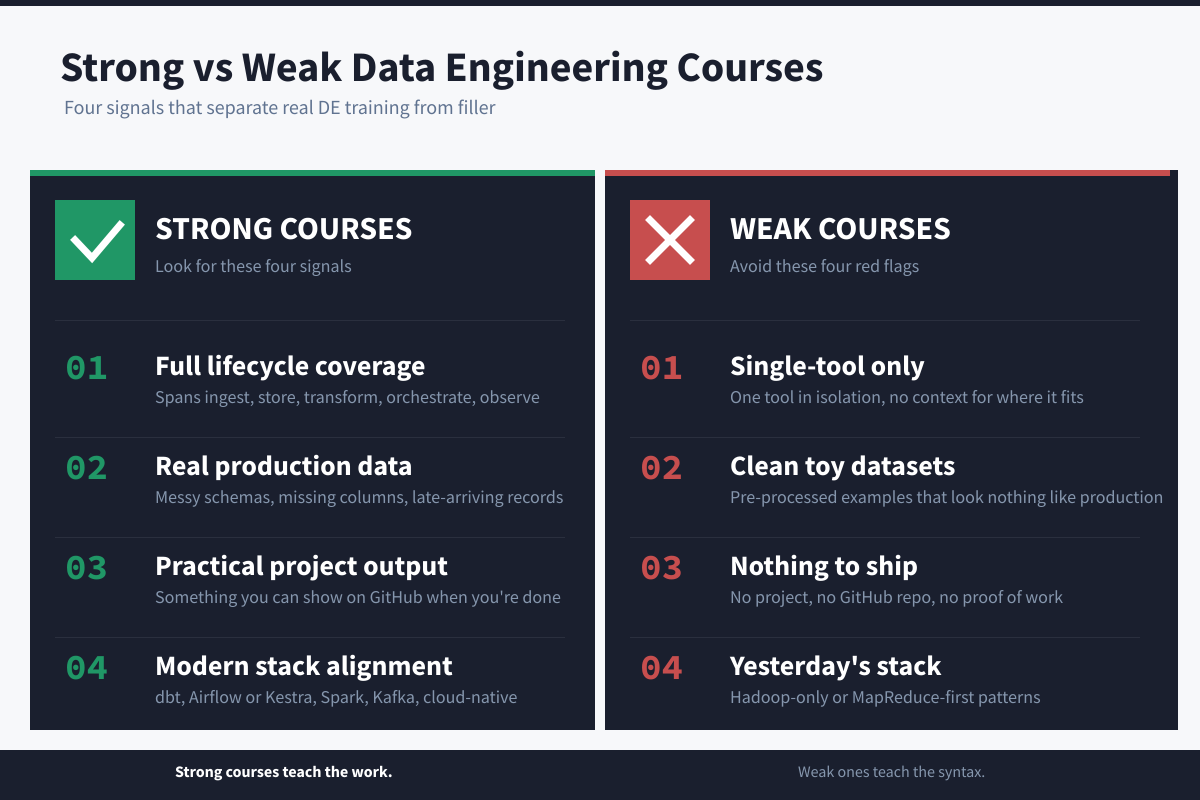
Data engineering is harder to teach than most adjacent fields because it covers more ground. A good data engineer needs to ingest data from messy sources, model it for analytics, transform it reliably, orchestrate it, observe it in production, and do all of that on a cloud platform. Most courses cover one or two of those pieces and skip the rest.
Four signals tell strong data engineering courses from weak ones:
- Lifecycle coverage that goes past one tool. Real data engineer training spans the full pipeline (ingest, store, transform, orchestrate, observe), not just one stage. Single-tool courses (dbt, Airflow, Spark) are valuable, but only after you understand where they fit.
- Real pipelines against messy data, not toy examples. The best courses give you data with missing columns, schema drift, late-arriving records, and the kind of mess production pipelines actually carry.
- Modern stack alignment. Today's data engineers work with dbt, Airflow or Kestra, Spark, Kafka, and a cloud platform (AWS, GCP, or Azure). Courses still centering Hadoop-first patterns are pointing you at an older stack.
- Hands-on practice in the tool, not just watching. Interactive exercises that fail fast and give immediate feedback teach faster than passive video.
With those four signals in mind, here are the 10 top picks for 2026, organized by track: foundations, hands-on projects, modern toolchain, and cloud platform. Within each track, courses are ordered from most-recommended down.
Best Data Engineering Courses for Learning the Foundations
These three courses give you the broadest possible introduction to data engineering. Each takes a different angle: focused Python skills for DE work, a comprehensive 6-month ground-up certificate, or a 3-month course taught by the author of the canonical DE textbook. Start here if you've never built a pipeline.
1. Dataquest Data Engineer Career Path
- Cost: Free intro lessons (no credit card required). Full path access requires a paid plan: ~\$49/month.
- Time to Complete: 6-12 months at the recommended pace (~5 hours per week). Compressible to 4-6 months at 10+ hours per week.
- Prerequisites: None. The path starts from zero Python and SQL.
- What You'll Learn:
- Python programming for data engineering workflows
- PostgreSQL, Snowflake, and MongoDB for production databases
- Building ETL and ELT pipelines with Python and SQL
- Pipeline orchestration with Apache Airflow
- Distributed processing with PySpark
- Containerization with Docker and Kubernetes
- Cloud deployment on AWS
- Data transformations with dbt
- Best For: Learners who want a structured, job-ready path to data engineering from scratch, with portfolio projects built along the way.
Why it works: The Dataquest Data Engineer Career Path covers the full stack that modern DE roles require: Python, SQL, pipeline orchestration, distributed computing, containerization, and cloud deployment. Every course includes guided projects designed to build your portfolio as you learn.
The browser-based interactive environment means you write real code against real datasets from lesson one, with immediate feedback. No setup friction, no context-switching to your local machine.
By the end of the path, you'll have 14+ substantial projects demonstrating real skills. That's the portfolio story employers actually want to see.
Worth knowing: This is a multi-month commitment, not a quick course. If you want to try the platform first, Dataquest offers free intro lessons with no credit card required. For the credential angle, see our Best Data Engineering Certifications guide.
2. IBM Data Engineering Professional Certificate
- Cost: Free to audit individual courses. ~\$45/month on Coursera for the full certificate.
- Time to Complete: ~5 months at 10 hours/week (16 courses depending on current curriculum).
- Prerequisites: None. Designed for absolute beginners with no programming background.
- What You'll Learn:
- SQL with PostgreSQL and MongoDB
- Python programming fundamentals for data work
- Building ETL pipelines with Apache Airflow and Kafka
- Big data tools: Hadoop, Spark, NoSQL databases
- Data warehouse design and dimensional modeling
- Generative AI basics for data engineers
- Hands-on labs and capstone project
- Industry Recognition: Over 175,000 learners enrolled per Coursera. ACE-recommended for up to 12 college credits. IBM brand carries weight with employers in enterprise environments.
- Best For: Complete beginners who need a structured ground-up curriculum and want a comprehensive intro before specializing.
Why it works: The IBM Data Engineering Professional Certificate is the most comprehensive single program for absolute beginners. 5 months at 10 hours per week is a real commitment, but the breadth is the value.
You finish with exposure to the full DE landscape: SQL, Python, ETL with Airflow and Kafka, big data tools, data warehousing, and even an introduction to generative AI workflows. That vocabulary lets you have intelligent conversations about data engineering before you've specialized.
The free audit option gives you the lecture content; the paid certificate adds graded labs and the credential.
Worth knowing: The breadth is the value here, but it comes with a tradeoff: 16 courses covering SQL, Python, ETL, Airflow, Kafka, Spark, data warehousing, and NoSQL means each topic gets introduction-level treatment rather than deep expertise. Think of this as a strong foundation to build from, not a finishing program. Certifications guide.
3. DeepLearning.AI + AWS Data Engineering Professional Certificate
- Cost: Free to audit. Paid certificate available through Coursera.
- Time to Complete: 3 months at 5 hours per week. 4-course series
- Prerequisites: Intermediate Python programming and familiarity with data structures.
- What You'll Learn:
- The data engineering lifecycle framework (Reis/Housley)
- Designing data models for analytics workloads
- Building scalable pipelines on AWS
- Working with Spark, Hadoop, and Kinesis for batch and streaming
- Cloud-native storage and compute patterns
- End-to-end capstone projects
- Industry Recognition: Taught by Joe Reis, co-author of "Fundamentals of Data Engineering," widely cited as the field's foundational textbook. Produced in partnership between DeepLearning.AI and AWS. Over 30,000 learners enrolled on Coursera.
- Best For: Intermediate learners who want the canonical DE conceptual framework taught directly by the author who wrote the textbook.
Why it works: The DeepLearning.AI + AWS Data Engineering Professional Certificate is the under-the-radar gem in the DE course landscape. Joe Reis built the data engineering lifecycle framework that's now the field's shared vocabulary, and he teaches it here directly.
The AWS partnership means the cloud-pipeline implementations are production-grade rather than toy examples. You build real data systems on real cloud infrastructure.
For learners who want to read DE papers comfortably and think systematically about pipeline design, this is the foundation that makes it possible.
Worth knowing: Requires intermediate Python going in. AWS-specific implementations are what they are, though the conceptual frameworks transfer across cloud platforms. Pair with the "Fundamentals of Data Engineering" book by Reis and Housley for the strongest learning combination.
Best Hands-On Data Engineering Courses with End-to-End Projects
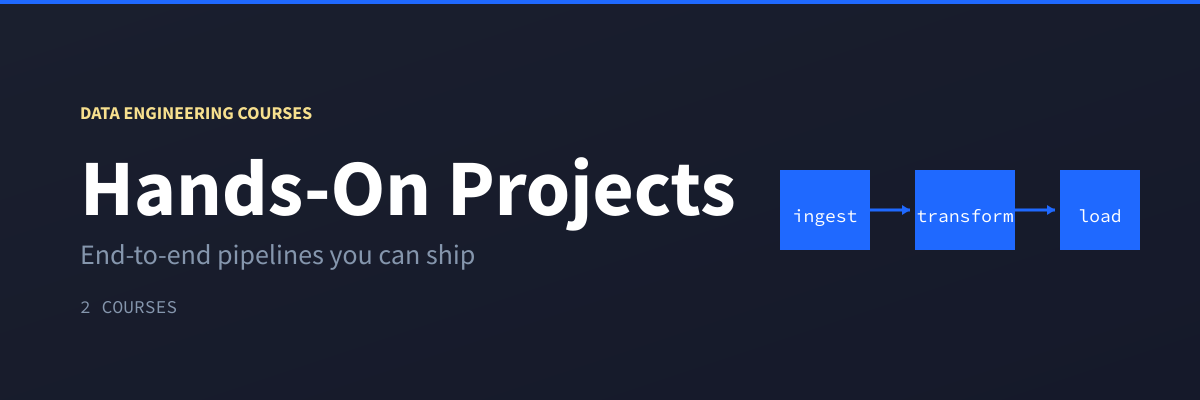
These are the best data engineering courses online with end-to-end projects you can put on a portfolio. The first is a free community-driven curriculum that runs as a 9-week cohort or self-paced; the second is a paid interactive Python-heavy track. Both teach modern tools through actual pipelines.
4. DataTalks.Club Data Engineering Zoomcamp
- Cost: Free (all materials open-access on GitHub).
- Time to Complete: 9-week structured cohort OR self-paced through GitHub materials year-round.
- Prerequisites: Command line comfort, basic SQL. Python helpful but not strictly required.
- What You'll Learn:
- Infrastructure with Docker and Terraform
- Workflow orchestration with Kestra (formerly Airflow in earlier cohorts)
- Data warehousing with Google BigQuery on GCP
- Analytics engineering with dbt
- Batch processing with Apache Spark and Spark SQL
- Stream processing with Kafka and KSQL
- End-to-end capstone project building a production-style pipeline
- Industry Recognition: Popular free DE course with a large GitHub community; the repo currently has 38,000+ stars. Active DataTalks.Club Slack community in the #course-data-engineering channel.
- Best For: Intermediate learners who want production-grade hands-on practice and don't want to pay.
Why it works: DataTalks.Club's Data Engineering Zoomcamp is what Reddit consistently calls the best free DE course, and the consensus is right. The 9-week curriculum spans the entire modern data stack: Docker, Terraform, dbt, Spark, Kafka, and a real capstone.
The GitHub-hosted materials remain accessible year-round, so you can self-pace whenever the cohort doesn't fit your schedule.
What sets it apart is the community. The DataTalks.Club Slack stays active between cohorts and former students help newcomers, which is rare for free courses.
Worth knowing: The cohort runs once per year (typically January), so for year-round access you'll work through the GitHub materials at your own pace without peer reviews. For the cohort-with-accountability experience and a comparison against other cohort-based programs, see our Best Data Engineering Bootcamps guide, which covers DE Zoomcamp as a free cohort bootcamp. Self-pacing requires real discipline.
5. DataCamp Data Engineer in Python Career Track
- Cost: Paid DataCamp subscription, typically ~\$25-35/month (annual plans cheaper).
- Time to Complete: ~40 hours across multiple courses and projects.
- Prerequisites: Prior Python knowledge and familiarity with cloud concepts.
- What You'll Learn:
- Python data engineering fundamentals and ETL patterns
- Working with data ingestion using pandas and SQLAlchemy
- Apache Airflow for workflow orchestration
- Git version control for data code
- Efficient coding practices for data pipelines
- Hands-on projects throughout
- Industry Recognition: One of the larger paid Python-focused DE tracks available. DataCamp's interactive in-browser format is widely praised for keeping learners active rather than passive.
- Best For: Python developers leveling up to data engineering through interactive in-browser exercises.
Why it works: DataCamp's Data Engineer in Python Career Track takes a Python-centric approach to DE that's compact (~40 hours) and project-driven.
Every lesson runs in the browser with immediate feedback, which keeps you coding rather than watching. The track progresses from Python data libraries through Airflow and dbt, giving you a working foundation in the modern Python DE stack.
For learners who already know Python and want a focused, time-bounded ramp into DE skills, the ~40-hour commitment is appealing.
Worth knowing: The DataCamp subscription model means ongoing cost as long as you're using the platform. This track focuses on Python and Airflow; for PySpark or dbt coverage within DataCamp, those require their separate "Professional Data Engineer in Python" track.
Best Data Engineering Courses for the Modern Toolchain
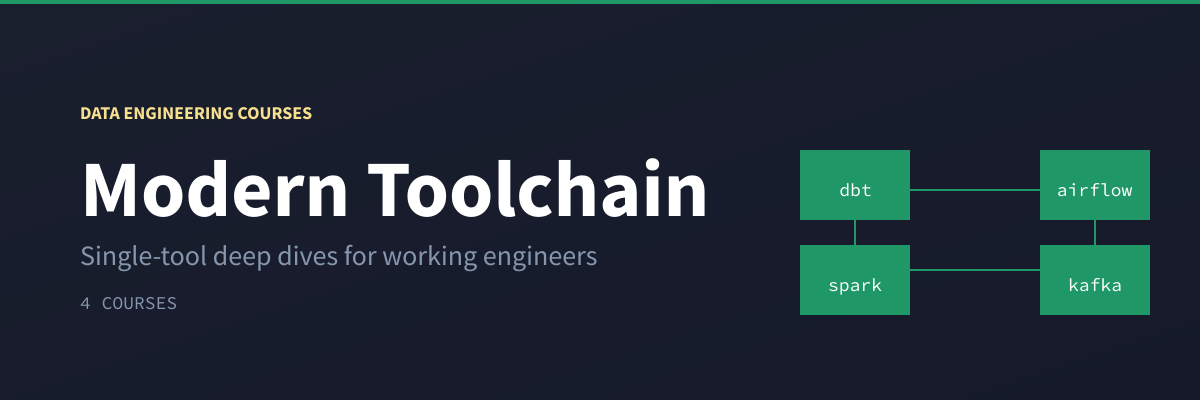
These four courses each focus on one tool that's become essential in modern data engineering. The first three (dbt, Airflow, Kafka) are free intros under five hours, each produced by the company that maintains the tool. The fourth (Databricks) is a paid 16-hour course for engineers who already work with Spark and want production-grade depth. Take them as needed when a specific skill gap shows up.
6. dbt Fundamentals
- Cost: Free (free Learn.getdbt.com account required).
- Time to Complete: ~5 hours, self-paced.
- Prerequisites: SQL fundamentals (SELECT, JOIN, aggregations, CTEs).
- What You'll Learn:
- dbt Core and dbt Cloud basics
- Project structure and configuration
- Models, materializations, and incremental builds
- Refs and sources for data lineage
- Tests and documentation as code
- Deploying dbt projects in production
- Industry Recognition: Official curriculum from dbt Labs. dbt is widely used as a modern transformation framework across analytics engineering and data engineering work.
- Best For: Analytics engineers and data engineers learning dbt for transformation work for the first time.
Why it works: dbt Fundamentals is the official course from the team that built dbt, and it shows. The pacing is tight, the explanations skip filler, and you build a small but realistic dbt project end to end.
dbt has become the standard transformation framework in data work. Knowing it well is high-leverage; the 5-hour investment pays back fast.
The course covers both dbt Core (open-source) and dbt Cloud (managed), so you understand the patterns regardless of which deployment path your team chooses.
Worth knowing: dbt Fundamentals leans on dbt Cloud, though many concepts transfer to dbt Core. If you want more guided hands-on practice after this course, Dataquest's Data Transformation with dbt course covers production-ready transformation patterns, including testing, documentation, and deployment workflows.
7. Apache Airflow Fundamentals (Astronomer Academy)
- Cost: Free.
- Time to Complete: 2.5 hours.
- Prerequisites: Python basics.
- What You'll Learn:
- Airflow concepts: DAGs, operators, tasks, dependencies
- Setting up a local Airflow development environment
- Writing your first DAG end to end
- Scheduling, triggering, and backfilling
- The Airflow UI for monitoring pipelines
- XComs, sensors, connections, and variables
- Debugging failed tasks and reading logs
- Industry Recognition: Official course from Astronomer, the primary commercial Airflow vendor. Airflow is the dominant workflow orchestration tool in modern DE.
- Best For: Engineers learning workflow orchestration for the first time.
Why it works: Astronomer's Airflow Fundamentals course is the cleanest path to learning Airflow. It's tightly scoped (just Airflow, not the broader ecosystem) and produced by the company that employs many of Airflow's core maintainers.
You write real DAGs from lesson one, run them locally with Astro CLI, and see the Airflow UI working against your own pipelines. That hands-on framing makes Airflow's mental model click faster than reading docs.
Airflow has become the orchestration standard, so this is one of the highest-leverage short courses you can take.
Worth knowing: At ~2.5 hours, this is a focused foundations course, not a comprehensive guide to production Airflow. Astronomer Academy offers more advanced Airflow courses (DAG authoring, deferrable operators, production deployment) for next steps. Note that the DataTalks.Club Zoomcamp uses Kestra for orchestration rather than Airflow, so if you're working through the Zoomcamp, you'll encounter both tools in the ecosystem.
8. Advanced Data Engineering with Databricks
- Cost: \$1,500 for instructor-led classes. Self-paced version available via Databricks Academy subscription.
- Time to Complete: 16 hours across four 4-hour modules.
- Prerequisites: Intermediate PySpark and Delta Lake experience, Databricks Workspace familiarity, and basic Git. This course assumes you already work with Databricks.
- What You'll Learn:
- Spark Structured Streaming with Lakeflow declarative pipelines
- Auto Loader patterns and Bronze/Silver/Gold layering
- Databricks data privacy: PII handling, Unity Catalog security, pseudonymization
- Spark performance tuning: data skipping, liquid clustering, shuffle optimization, instance selection
- Declarative Automation Bundles for CI/CD-driven deployment
- Multi-environment pipeline deployment with GitHub Actions
- Industry Recognition: Official Databricks Academy training. Aligns directly with the Databricks Certified Data Engineer Professional credential. Serves as the standard onboarding framework for Databricks’ own senior technical staff and field engineers.
- Best For: Data engineers already working with Databricks who want to deepen their production skills.
Why it works: Advanced Data Engineering with Databricks is the course working Databricks practitioners take when they need to go past Spark fundamentals into production patterns.
The 16 hours cover what actually matters in real Databricks shops: streaming pipelines with Lakeflow's declarative syntax, Delta performance tuning at scale, Unity Catalog security patterns, and CI/CD with Databricks Asset Bundles. Each module is taught by Databricks engineers, not generic instructors.
The four modules connect into a complete picture of running Databricks in production rather than just learning the syntax.
Worth knowing: Substantial prerequisites. This assumes you already know PySpark, Delta Lake, and the Databricks workspace. Complete beginners should start with the free Databricks Academy fundamentals courses first. The \$1,500 price covers instructor-led delivery; the self-paced option through a Databricks Academy subscription is the lower-cost route. For the Databricks Certified Data Engineer Associate or Professional credential, see our Best Data Engineering Certifications guide.
9. Confluent Developer: Apache Kafka 101
- Cost: Free.
- Time to Complete: ~1.5 hours (video content; hands-on exercises add additional time).
- Prerequisites: Basic command line, familiarity with data systems concepts.
- What You'll Learn:
- Kafka core concepts: topics, brokers, producers, consumers, partitions
- Event streaming fundamentals
- Hands-on practice with Confluent Cloud (free tier)
- Basic stream processing patterns
- When Kafka fits versus other messaging systems
- Industry Recognition: Official Confluent Developer curriculum. Kafka is the de facto event-streaming standard across modern DE.
- Best For: Engineers learning event streaming and real-time data pipelines for the first time.
Why it works: Confluent's Kafka 101 course is the cleanest introduction to a tool whose docs are otherwise dense. The hands-on practice with Confluent Cloud's free tier lets you spin up real Kafka clusters in minutes.
Real-time streaming is increasingly common in modern data work, especially for event-driven products, monitoring, personalization, and operational analytics.
The course covers when Kafka fits versus alternatives like RabbitMQ or Kinesis, which is unusual honesty for a vendor course.
Worth knowing: The focus is on Confluent Cloud (managed Kafka) rather than self-hosted Kafka. For the Confluent Certified Developer for Apache Kafka (CCDAK) credential, see our Best Data Engineering Certifications guide. For streaming integrated into a full DE pipeline, the DataTalks.Club Zoomcamp covers Kafka with KSQL.
Best Data Engineering Courses for Cloud Platform Learning
Modern data engineering happens on a cloud platform. Of the three major providers (AWS, GCP, Azure), Google Cloud's Professional Data Engineer certification stands out as the cloud-focused option for this list because it's deeply data-specific, the exam validates real skills rather than just familiarity, and Google Cloud Skills Boost provides free preparation paths.
10. Google Cloud Professional Data Engineer Certification Prep
- Cost: Free study materials and learning paths on Google Cloud Skills Boost. Exam fee: \$200 (plus applicable taxes).
- Time to Complete: Variable depending on existing GCP experience. Google recommends 3+ years of industry experience and 1+ years of GCP hands-on work before the exam.
- Prerequisites: None. However, working knowledge of data engineering concepts, Python or SQL, and hands-on GCP experience will make the learning path more manageable.
- What You'll Learn:
- Designing data processing systems on Google Cloud
- Building and operationalizing data pipelines with Dataflow, Pub/Sub, and Cloud Composer
- Data storage and modeling with Google BigQuery and Cloud Storage
- Security, governance, and monitoring of data systems
- Integrating ML into data pipelines on GCP
- Industry Recognition: Professional-level Google Cloud credential, valid for two years. GCP has significant market share in data-heavy and ML-forward organizations. The exam is rigorous, covering real design and implementation decisions rather than memorized facts.
- Best For: Engineers targeting GCP-centric organizations or who already work with Google Cloud data tooling.
Why it works: The Google Cloud Professional Data Engineer certification is a meaningful credential because it's genuinely hard to pass without real experience. The exam tests architectural judgment across BigQuery, Dataflow, Pub/Sub, and Cloud Composer in ways that reward practitioners over test-preppers.
Google Cloud Skills Boost provides free self-paced learning paths that align with the exam topics, making this one of the most accessible cloud certifications to prepare for on a budget.
Worth knowing: GCP has a smaller footprint than AWS in some regional job markets. AWS and Azure offer comparable certification paths. If your target employer's stack is Azure-heavy, Microsoft's free Data Engineer Training on Microsoft Learn and the DP-700 certification path may be a better fit. For the full cloud certification landscape across all three providers, see our Best Data Engineering Certifications guide.
When You Actually Need a Data Engineering Course
You'll get more from a structured DE course (paid or free) if:
- You're starting from zero with no programming background. Effective DE requires Python comfort plus SQL fluency plus data modeling intuition plus a working knowledge of pipeline tools. A structured course saves months of false starts compared to self-directed learning from blog posts.
- You're changing careers into DE but don't want a multi-month bootcamp. Courses are the middle ground between casual tutorial-watching and full-time immersive programs. If you want bootcamps specifically, see our Best Data Engineering Bootcamps guide.
- You need to learn a specific tool for your current job. dbt, Airflow, Spark, or Kafka skills can be added in 4-6 hours each through the free official courses listed above. Targeted learning beats broad surveys when the skill gap is specific.
- You want to validate interest before committing to a longer program. Working through one of the foundations courses (#1-3 above) takes between 10 hours and 6 months depending on the depth, and tells you whether DE work suits you before you spend on a bootcamp or certification.
When You Should Skip the Course (Bootcamp or Cert May Fit Better)
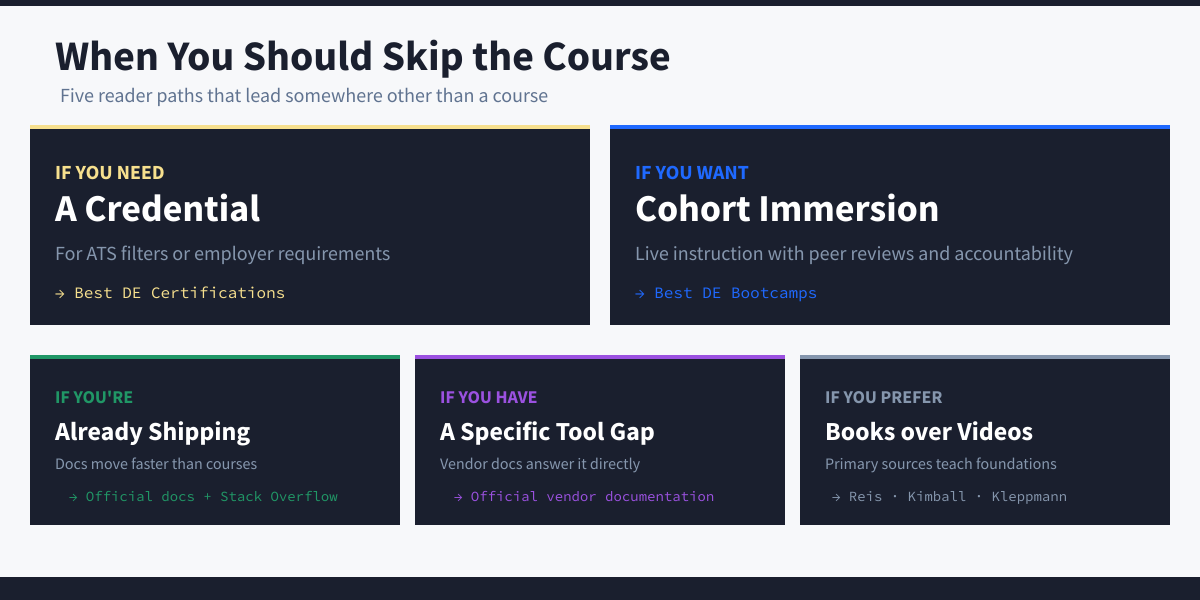
You can probably skip a course-based path if:
- You're starting from zero with no programming background. Effective DE requires Python comfort plus SQL fluency plus data modeling intuition plus working knowledge of pipeline tools. A structured course saves months of false starts compared to self-directed learning from blog posts.
- You're changing careers into DE but don't want a multi-month bootcamp. Courses are the middle ground between casual tutorial-watching and full-time immersive programs. If you want bootcamps specifically, see our Best Data Engineering Bootcamps guide.
- You're already shipping production pipelines. Working DE practitioners often get more from the official Apache Airflow docs, dbt's documentation, and Kaggle/GitHub project work than from another structured course.
- You have a narrow, specific tool gap and the official docs are clear. dbt's docs, Spark's documentation, Kafka's docs, and Airflow's reference are all genuinely well-written. If you can read documentation comfortably, you may not need a full course for the specific gap.
- You learn better from primary sources. Joe Reis and Matt Housley's "Fundamentals of Data Engineering" and Ralph Kimball's "The Data Warehouse Toolkit" remain the canonical books. For some learners, two months of book-reading plus a small project teaches more than any course.
Making Your Data Engineering Course Decision
The "best data engineering courses" lists you've been reading aren't wrong, they're just trying to serve everyone at once. The right course for you depends on whether you're starting from zero, leveling up a specific skill, or rounding out a foundation you already have.
The best way to learn data engineering is to pick one course this week, finish it, and apply what you learned to a real pipeline (even a small one). A quick shortcut by where you are:
- You're a complete beginner who wants to get job-ready: The Dataquest Data Engineer Career Path gives you a structured, project-driven path from zero to job-ready, covering Python, SQL, Airflow, Spark, dbt, and cloud deployment. Free intro lessons let you try the platform before committing.
- You want a comprehensive 6-month foundation: The IBM Data Engineering Professional Certificate on Coursera covers SQL, Python, ETL, big data, and a capstone, all from absolute zero. Free to audit, paid certificate available.
- You want a course taught by the industry's canonical author: The DeepLearning.AI + AWS Data Engineering Professional Certificate is taught by Joe Reis. Free to audit. Pair with his book "Fundamentals of Data Engineering."
- You want free hands-on practice with the modern toolchain: DataTalks.Club's Data Engineering Zoomcamp is what working data engineers consistently recommend. Free, comprehensive, project-based.
- You need a specific tool skill right now: Pick the relevant tool course from the Modern Toolchain section (dbt, Airflow, Databricks, or Kafka). The free official courses are short, focused, and produced by the companies that maintain the tools.
Pick one. Block study time on your calendar. Finish it before enrolling in another. Then build a real pipeline (data from a public API, transformed with dbt, orchestrated with Airflow, deployed somewhere you can show employers). The market teaches you which patterns matter, and you'll learn faster solving real problems than collecting more courses.
Frequently Asked Questions
Should I take a course, a bootcamp, or a certification first?
Start with a course if you want flexibility and lower commitment. Courses range from 3 hours (single-tool deep dives) to 6 months (comprehensive foundations) and let you test whether DE work suits you before spending thousands on a bootcamp or a paid certification exam.
Move to a bootcamp if you want immersive cohort-based learning with peer accountability, live instructors, and structured career support. Move to a certification if you need a credential for ATS filters or employer-mandated requirements. Most successful data engineers combine all three over time: foundations through courses, depth through projects, and a credential or two for credibility.
Are data engineering courses worth it in 2026 with all the AI hype?
Yes, and the core reasons haven't changed. Data engineers build the infrastructure that powers analytics, machine learning, and business decisions across every industry. The pipelines feeding dashboards, the systems enabling BI, and the data quality foundations that make any downstream product reliable are all DE work. AI tools can help write code, but they can't replace architectural judgment, system design decisions, or business context.
The hype has shifted toward generative AI applications, but the durable skills (pipeline orchestration, schema design, data quality, observability) are more valuable than ever. Modern DE learners use AI tools to accelerate learning, but the fundamentals still need to be there.
How much Python and SQL do I need before starting?
You need comfort with basic Python (variables, functions, lists, dictionaries, file handling) and intermediate SQL (joins, aggregations, CTEs, subqueries). Most foundations-track courses on this list teach the rest as you go, but the beginner courses will move slowly if you're learning Python from scratch at the same time.
If you don't have those basics yet, work through Dataquest's Data Engineer Career Path, which starts from zero Python and SQL. Specialized tool courses (dbt, Airflow, Spark, Kafka) usually assume both Python and SQL already, so save those for after the foundations are solid
How long does it take to be job-ready in data engineering?
Realistic timeline: 9 to 18 months at 10-15 hours per week of focused study, including portfolio project work. Faster if you already program in Python and know SQL well. Slower if you're starting from zero with no programming background.
Job-ready means more than completing a course. It means a portfolio of 2-3 end-to-end pipelines on GitHub: data ingested from a public API, transformed with dbt, orchestrated with Airflow or Kestra, and deployed somewhere employers can see. A working data engineer's portfolio shows production thinking (testing, error handling, observability) not just successful runs. Apply for roles before you feel fully prepared. The market teaches you what skills actually matter.
Do I need a certification to land a DE job?
Not always, but credentials help in specific situations. Cloud certifications (AWS, GCP, Azure) appear in many DE job postings as preferred or required. They matter most for career changers without traditional DE experience, for ATS keyword filters, and in industries that value formal credentials (finance, healthcare, government). For the full breakdown of which DE certifications are worth pursuing, see our Best Data Engineering Certifications guide.
Free vs paid DE courses: what's the real difference?
Free DE courses can be genuinely excellent. DataTalks.Club's Zoomcamp, dbt Fundamentals, Astronomer's Airflow course, Confluent's Kafka 101, and Microsoft Learn's Data Engineer training are all high-quality and free. For specific-skill learning, free official courses from the vendors that maintain the tools are often better than paid courses.
What you pay for is structure that holds you accountable: an interactive practice environment with progress tracking, graded projects that build a portfolio, and a community that keeps you moving when motivation dips. For learners who've stalled on free resources before, that structure pays for itself in completion rates alone.
Which specific tools should I learn first?
Start with the four pillars of modern DE: SQL (you should already have this), Python, an orchestration tool (Airflow), and a transformation tool (dbt). With those four, you can build real pipelines. Add Spark when you start working with data above a few hundred gigabytes. Add Kafka when streaming becomes part of your work.
For cloud platforms, pick one based on the job market in your area or your target employer's stack. AWS appears in the most postings overall, GCP commands the highest average salaries, Azure dominates enterprise. All three teach transferable patterns. The specific tool inventory matters less than the depth you go on each.
from Dataquest https://ift.tt/VepcwKT
via RiYo Analytics


No comments